FitFoodz sells relief, not dinner. That is the real pitch. Strip away the glossy macros and the tidy packaging, and the product sits in a very specific gap: for people who do not want to chop, wash, brown, stir, or even think about a pan.
That gap is bigger than UCook’s world and smaller than a full takeaway habit. It is the space between “I should cook” and “I am ordering something expensive and greasy because I have already given up on cooking tonight.”
The claim sounds cleaner than the product stack
FitFoodz likes to frame itself as the smarter alternative to meal kits, but that comparison flatters it. UCook sends measured ingredients and recipe cards, then hands the actual work back to you. FitFoodz removes the work entirely. It sends chef-prepared frozen meals that need only a few minutes of heating. That is a different business, a different habit, and a different decision at checkout.
The company also runs a regional cold-chain model, with stock held in depots closer to major delivery areas. The website does not let every customer order every meal; it shows only what is actually available from the depot assigned to that address. You are not being sold a fantasy inventory that later needs substitution theatre.
This is sensible operations. It is also a reminder that FitFoodz is not built like a supermarket app or a family meal-kit business. It is a controlled convenience machine.
A week of meals tells a less flattering story
The sharpest way to test the claim is to compare a week of eating, not one carefully chosen hero meal.
Using the ranges in FitFoodz’s own market position, a week of five meals lands around R425 to R600, or roughly R85 to R120 a portion. Protein sits in the 28g to 40g range per meal, with total energy around 1600 kJ to 2200 kJ.
A UCook box looks cheaper at first glance if you ignore that it is built for people who still cook. A typical weekly order of three dinners for two people, six portions in total, runs about R420 to R600, or roughly R70 to R100 a portion. Protein is higher, around 35g to 55g per portion, and the energy load is also higher, at about 2000 kJ to 3000 kJ.
Supermarket ready meals sit lower again. A week of five portions can come in around R225 to R400, or R45 to R80 each. Protein usually lands between 20g and 35g, with energy between 1400 kJ and 2300 kJ.
The scorecard looks like this:
| Option | Price per portion | Protein per portion | Energy per portion | Delivery cost | Prep time |
|---|---|---|---|---|---|
| FitFoodz | R85 to R120 | 28g to 40g | 1600 kJ to 2200 kJ | R50 to R90, often free above a threshold | 2 to 5 minutes |
| UCook | R70 to R100 | 35g to 55g | 2000 kJ to 3000 kJ | R0 to R70, often bundled or waived on some plans | 20 to 45 minutes active cooking |
| Supermarket ready meals | R45 to R80 | 20g to 35g | 1400 kJ to 2300 kJ | R0 in store, up to about R80 for grocery delivery | 5 to 10 minutes |
The table exposes the trick in the FitFoodz pitch. It is not obviously better value than UCook on price. It is not cheap enough to beat supermarket ready meals. It is buying time, not calories, and it is charging for the privilege.
The real rival is not meal kits
FitFoodz is not fighting a battle against raw ingredients in a family kitchen. That is the wrong war.
Its actual competitors are the things people really use when life gets noisy: takeaway lunches from Uber Eats, Mr D Food or Bolt Food; deli meals from Woolworths Food, Checkers Food or Pick n Pay; a premade salad from a supermarket fridge; the half-planned Sunday meal-prep session that ends with four containers, a sink full of dishes, and a resignation text to yourself by Wednesday.
That is the lane FitFoodz is in. It is convenience food with better branding and more disciplined nutrition. That is a much more honest positioning than pretending it belongs in the same conversation as a meal kit.
Heating changes the product more than the website admits
A frozen meal can look tidy on a screen and ordinary in a bowl. That gap is where a lot of ready-meal brands become theatrical.
Vegetables are the first thing to go soft. Broccoli, spinach, cauliflower, green beans, all the watery stuff that looks bright and structured in a photo, tends to come out looser after freezing and reheating. Some of it turns limp. Some of it sheds water into the sauce. Some of it just looks tired.
Chicken is the other tell. Lean meat can go slightly dry, or give you that faintly rubbery bite that makes you stop pretending this is restaurant food. Sauces may loosen or split a little. The whole tray often needs a stir before it eats properly.
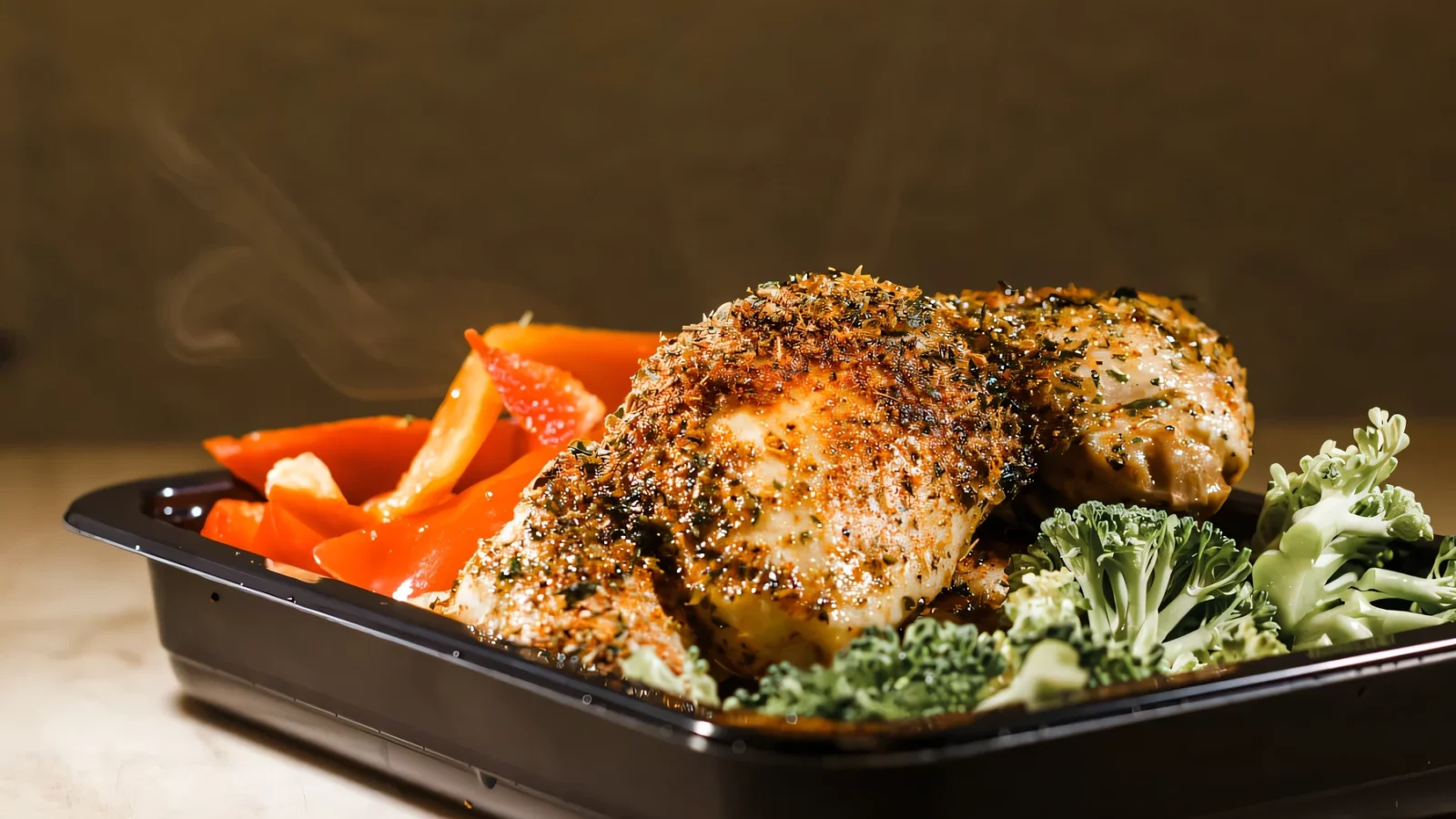
The kitchen photo matters less than the tray itself. FitFoodz presents the food the way a good ad shoot should: bright, neat, styled for appetite. The delivered meal has to survive the microwave and still earn your second bite. That is a harder test than the product page suggests.
If you are buying frozen convenience food, this is the real question: does it still taste like something you would pay for after heating, or does it become a tidy macro spreadsheet in a plastic tub?
Packaging is part of the cost, whether the brand likes it or not
UCook creates the most visible mess. You get a box, recipe cards, ingredient bags, small containers, and the usual cold-chain extras. It looks tidy in the cart and chaotic in the bin.
FitFoodz uses plastic meal trays, cardboard sleeves, insulated packaging and ice packs. It is less fiddly than a meal kit, but the cold-chain setup adds bulk. That is the trade: you are swapping kitchen work for warehouse work, and the packaging reflects it.
Supermarket ready meals are usually the least dramatic on the packaging front, especially if you pick them up in store. They still use trays and sleeves, but they do not arrive with the same dedicated delivery structure. That makes them cheap in the one place consumers actually feel cost: the final bill.
For a buyer trying to save money, the waste story mirrors the price story. More logistics usually means more cost. More convenience usually means someone else has to carry the mess.
Subscription language and refund language do the heavy lifting
FitFoodz is built around recurring orders, usually weekly or every two weeks, with the usual ability to pause or skip before the cut-off. That is standard subscription machinery. It reduces friction for the brand and makes the customer more predictable.
The depot model also shapes where the service works. It is concentrated around major metros such as Johannesburg, Cape Town, Durban and Pretoria, plus surrounding suburbs. The promise is not national in the everyday sense people hear on a homepage. It is regional, despite the broader marketing tone.
Refund terms for perishable goods are usually narrow. If an item is wrong, damaged, or spoiled, report it quickly and you have a case. You do not get a refund because you did not enjoy the sauce or because the texture was softer than the website photo suggested. That is normal for this category, but consumers should read it before assuming ready meals behave like retail goods with open-ended returns.
The dietary claims deserve the same caution. FitFoodz talks in macro language and weight-control language, but that is not the same as medical evidence. If a brand wants to sell weight loss as an outcome, it should show named qualified professionals and published method, not just tidy labels and testimonial energy. Otherwise it is selling portion control, which is fine, and dressing it up as something more serious, which is not.
The verdict is narrower than the marketing
FitFoodz is not a better version of UCook. It is a different product for a different moment. UCook serves the person who still wants to cook. FitFoodz serves the person who wants dinner to happen with almost no participation.
That is a real business. It can be a useful one. It is also easier to admire than to overpay for.
If you judge it against meal kits, the numbers do not deliver a knockout. If you judge it against takeaway lunches, premium deli food and the cost of repeatedly failing to meal prep on a Sunday, the pitch makes more sense. FitFoodz is not trying to beat your stove. It is trying to beat your weakest evening.